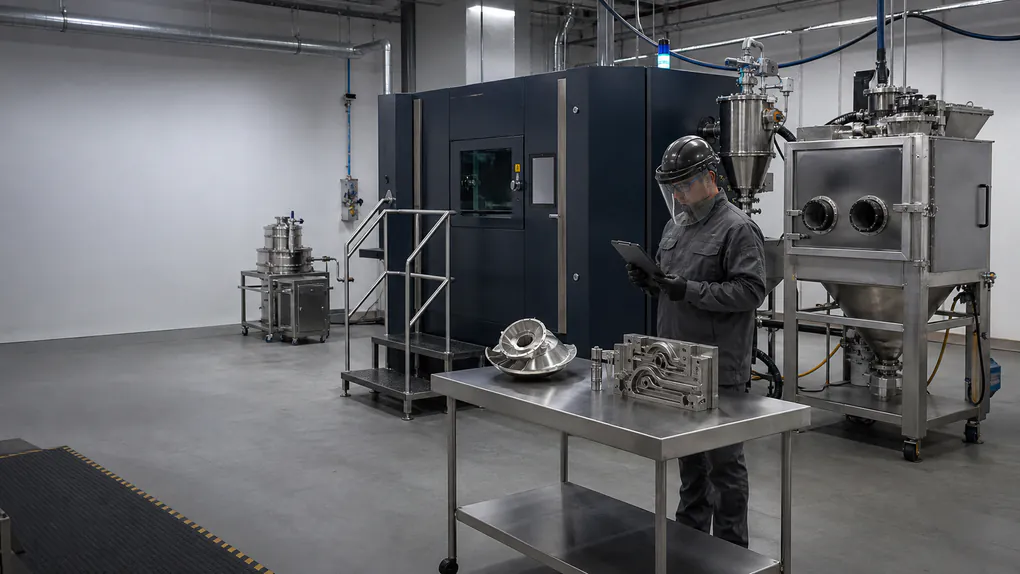
Unbranded industrial metal LPBF system with powder handling station and printed metal impeller

Metal LPBF systems · OEM & bulk procurement

Metal LPBF 3D Printers specified around your production requirement

Laser powder bed fusion systems scoped as complete production cells—from powder and atmosphere control to heat treatment, inspection, FAT and site acceptance.

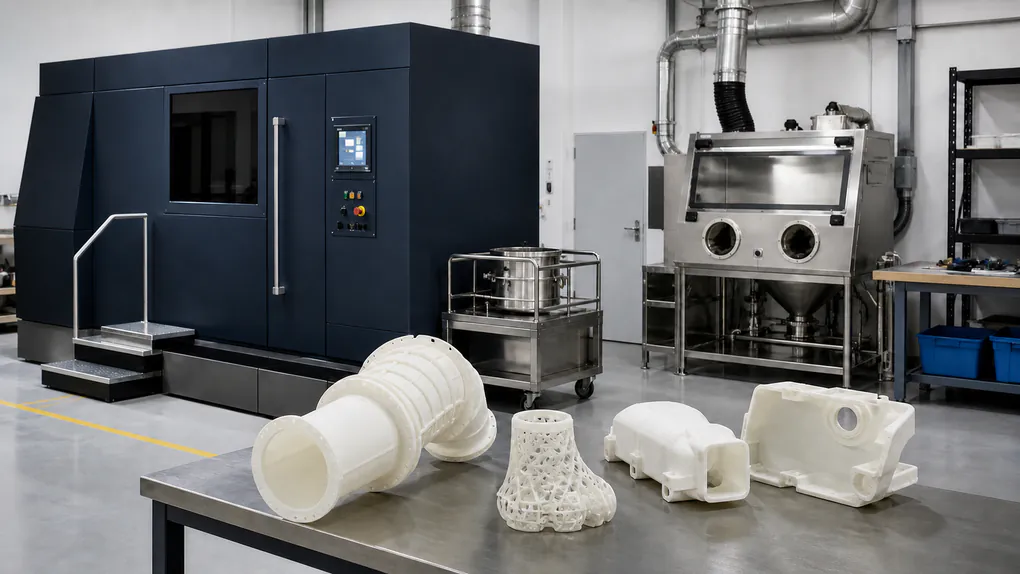
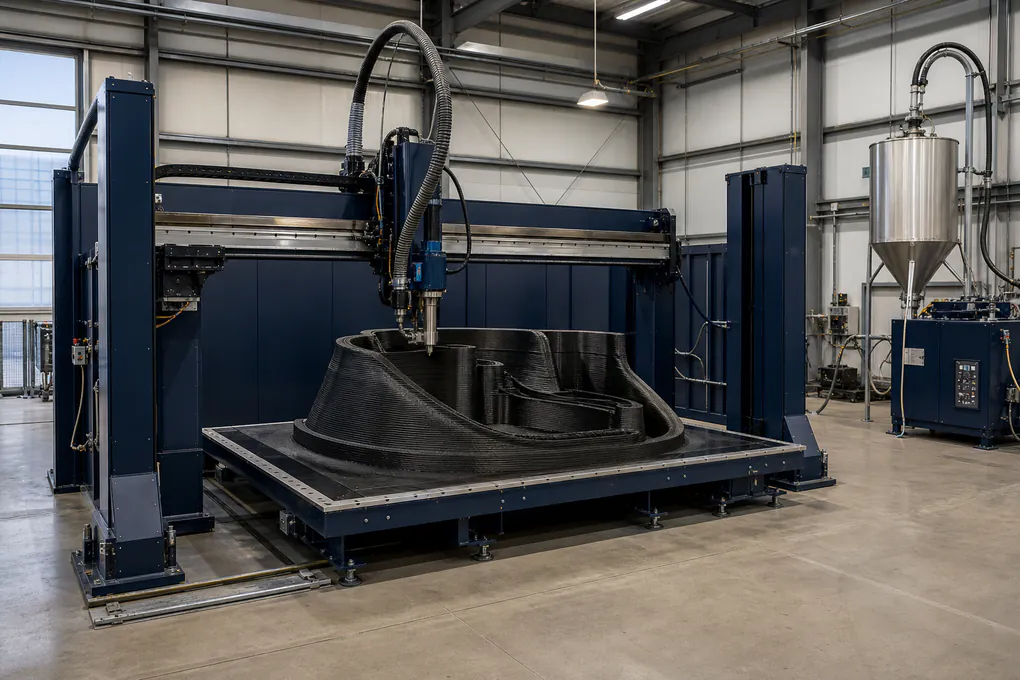
Illustrative technology image. The final proposal names the actual model, revision, production site and configuration.

Buyer painQuotes that cannot be compared because model scope, evidence and site work are different.
EverBen approachOne requirement brief, one return-field table and written acceptance gates.
Commercial modelMOQ, OEM program and bulk pricing are provided for the approved configuration.

EverBen equipment directory

14 EverBen models and series in this process family

Compare model summaries, configuration limits and adjacent models. Each detail page identifies its reference status and separates pending fields from reference values.

Current availability and the mapping to a quoted machine are pending confirmation for every record. Source specifications require a current signed datasheet; conflicting fields remain open.

SLM · Model

EverBen SLM M450Pro-X 3D Printer

SLM M450Pro-X: 450 × 450 × 500 mm LPBF build reference with unresolved laser/scanner row conflicts. The reported 10205 kg mass also needs a confirmed equipment boundary.

Build envelope
450mm*450mm*500mm
Layer setting
0.02-0.1mm
Laser
Pending confirmation — The laser row lists four 500 W sources, but the scanner row mixes two scanners with two 500 W sources. Laser and scanner counts need one configuration schedule.

Availability: pending confirmation · Needs configuration confirmation

SLM · Model

EverBen SLM M450Pro-S 3D Printer

SLM M450Pro-S: M450Pro-S requires a corrected configuration table: laser text occupied the recoating row and scraper text occupied the scanner row. Build height and footprint also remain pending.

Build envelope
Pending confirmation — Source records disagree on height or footprint; confirm usable height, the 50 mm baseplate exclusion and separate powder-module clearance.
Layer setting
30~100μm
Supply power
380VAC 3ph/N/PE

Availability: pending confirmation · Needs configuration confirmation
SLM · Model

EverBen SLM M300G 3D Printer

SLM M300G: M300G combines a disputed build envelope with a source-described 500 W green laser. Confirm the light-source identity, wavelength and copper process before dimensional or material selection.

Build envelope
Pending confirmation — Source records contain different build envelopes. A dated drawing must resolve the usable dimensions and revision.
Layer setting
0.02mm~0.1mm
Feedstock / material
Pure copper, Copper Alloys, Refractory Metals, Gold, Aluminum Alloys, High-temperature Alloys, Stainless Steel, Mold Steel, etc.

Availability: pending confirmation · Needs configuration confirmation
SLM · Model

EverBen SLM M150G 3D Printer

SLM M150G: 150 × 150 × 150 mm green-laser LPBF reference with up to 200 °C plate heating. The source-described 500 W laser lacks a model and wavelength.

Build envelope
150 × 150 × 150mm
Layer setting
0.02mm~0.1mm
Feedstock / material
Red copper, copper alloys, refractory metals, gold, aluminum alloys, etc.

Availability: pending confirmation · Needs configuration confirmation
SLM · Series

EverBen SLM M480 Series 3D Printer

SLM M480 Series: 480 × 320 × 300 mm rectangular LPBF reference with conflicting two/four-laser records. The 13 kW and material-package scope need the resolved configuration.

Build envelope
480mm*320mm*300mm
Layer setting
0.02-0.1mm
Laser
Pending confirmation — Source narrative and table disagree on two versus four lasers; confirm laser and scanner counts together.

Availability: pending confirmation · Needs configuration confirmation
SLM · Series

EverBen SLM M650 Series 3D Printer

SLM M650 Series: M650 has conflicting build-height records and four/eight 500 W laser options. The shared 21 kW and 50–100 cm³/h figures cannot define a quoted variant.

Build envelope
Pending confirmation — Source records contain different build envelopes. A dated drawing must resolve the usable dimensions and revision.
Layer setting
0.02~0.1mm
Laser
IPG 500W×4/8 (1064nm)

Availability: pending confirmation · Needs configuration confirmation

SLM · Model

EverBen SLM D100 3D Printer

SLM D100: Ø120 × 100 mm cylindrical LPBF reference with a single 300 W infrared fibre laser and no substrate preheating. Alloy, gas and output conditions need qualification.

Build envelope
Φ120mm*100mm
Layer setting
0.02~0.1 mm
Laser
300W Infrared Ytterbium-doped Fiber Laser ×1

Availability: pending confirmation · Needs configuration confirmation

SLM · Series

EverBen SLM M500 Series 3D Printer

SLM M500 Series: M500 lists four 500 W lasers, but its build envelope conflicts across source records. A malformed jump-speed range is also pending before configuration comparison.

Build envelope
Pending confirmation — Source records contain different build envelopes. A dated drawing must resolve the usable dimensions and revision.
Layer setting
0.02-0.2mm
Laser
IPG 500W×4 (1064nm)

Availability: pending confirmation · Needs configuration confirmation

Owner-supplied third-party catalog reference

Metal LPBF 3D Printers attributes to confirm in the named proposal

These ranges come from a third-party 2025 equipment catalog supplied by the site owner. They are not EverBen-branded specifications and do not prove manufacturing, authorization or current availability. A named manufacturer, authorization status and current signed datasheet must control any proposal or order.

ProcessLaser powder bed fusion / selective laser melting
Catalog reference build rangeResearch-to-production examples are shown, but conflicting large-format dimensions require a current signed model datasheet
Catalog laser referenceFiber-laser configurations from single source to multi-laser layouts; exact power/count must be confirmed
Catalog layer referenceModel-dependent layer ranges are shown; the named machine, alloy and qualified parameter revision must control
Cell systems to scopeInert gas, filtration, sieving, powder transfer, heat treatment, support removal and inspection
Buyer acceptance focusDensity, chemistry, oxygen, mechanical properties, dimensional result, repeatability and traceability

01 · Application fit · Metal LPBF

When Metal LPBF 3D Printers is the right process—and when another route is safer

LPBF selectively melts thin metal-powder layers under a controlled atmosphere to build dense geometries that may be difficult to machine conventionally.

The strongest starting cases for this Metal LPBF review are conformal-cooled mold inserts, aerospace and energy development parts, lightweight industrial components, metal additive research and parameter development. The intended output must still be separated into prototype, tooling, bridge production or released production because the evidence and responsibility change at each stage.

Metal LPBF go/no-go question

Can the proposed process meet the part duty, material route and acceptance method for conformal-cooled mold inserts without relying on an unverified brochure claim?

02 · Machine architecture · Metal LPBF

Metal LPBF 3D Printers architecture that changes the buying decision

Laser count and power, optical overlap, recoater, build and feed modules, filtration, gas flow, oxygen control and thermal strategy form one process architecture.

The proposal must name the installed configuration and explain how it supports conformal-cooled mold inserts. The process label is not enough when the build mechanism, thermal or optical design, feed system and accessories can change both performance and maintenance.

Metal LPBF configuration freeze

For the proposed Metal LPBF route, record the manufacturer, model, revision, installed options, cell boundary and every third-party dependency before quotations are compared.

03 · Build and footprint · Metal LPBF

Metal LPBF 3D Printers build envelope, part orientation and factory access

The owner-supplied catalog reference lists Research-to-production examples are shown, but conflicting large-format dimensions require a current signed model datasheet. Treat that only as an early planning range until the authorized manufacturer returns a current model and signed datasheet.

For aerospace and energy development parts, usable space depends on orientation, process margins, unloading and downstream handling. The site review must also cover machine footprint, packed size, weight, doorway route, floor loading and service clearance.

Metal LPBF space validation

Fit a representative aerospace and energy development parts part in the usable Metal LPBF envelope, then verify unloading, service access, packed dimensions and floor load for the named machine.

Have the part file or target specification?Send non-confidential inputs now; attach controlled files only after the project route is confirmed.
Open RFQ form

04 · Material route · Metal LPBF

Metal LPBF 3D Printers materials, conditioning and lot evidence

Metal powder needs alloy chemistry, particle-size distribution, morphology, moisture and oxygen control, lot traceability and defined reuse limits.

The material brief should connect the exact grade or SKU with storage, conditioning, the proposed Metal LPBF configuration, process parameters, post-processing and the property test method. Bulk or private-label discussions begin only after this compatibility route is defined.

Metal LPBF material qualification

Approve one traceable Metal LPBF grade or SKU with its TDS, SDS, lot evidence, conditioning, parameter revision and downstream process.

05 · Part quality · Metal LPBF

Metal LPBF 3D Printers accuracy, repeatability and the real error mechanisms

Residual stress, support strategy, scan layout, thermal history, plate release, heat treatment and machining allowance drive finished dimensions.

Use a representative lightweight industrial components geometry or an agreed coupon. Record orientation, material lot, build position, post-process, datum scheme, instrument and repeat count so input resolution cannot be mistaken for verified finished-part capability.

Metal LPBF measurement evidence

Use the same lightweight industrial components geometry, material, orientation, post-process, datums, instrument and repeat count for every Metal LPBF candidate.

06 · Output and TCO · Metal LPBF

Metal LPBF 3D Printers throughput measured as accepted parts

Qualified build rate must include recoating, warm-up, cool-down, powder recovery, filter change, plate handling, heat treatment and inspection.

A purchasing model for Metal LPBF should count preparation, changeover, build, cooling or curing, recovery, finishing, inspection, rejected parts and maintenance. Compare good parts per staffed shift and the consumables that control uptime rather than one peak speed value.

Metal LPBF capacity basis

Calculate accepted Metal LPBF parts per staffed shift with stated yield, changeover, downstream capacity, maintenance and consumable-life assumptions.

Have the part file or target specification?Send non-confidential inputs now; attach controlled files only after the project route is confirmed.
Open RFQ form

07 · Digital workflow · Metal LPBF

Metal LPBF 3D Printers software, parameter access and production data

Review build preparation, supports, scan strategy, parameter rights, melt-pool or process monitoring, records, export and secure remote service.

For a controlled conformal-cooled mold inserts workflow, ask about file preparation, profile revision, user roles, offline operation, job records, export, backup, licences and remote support. OEM interface or MES work needs a separate functional specification and acceptance test.

Metal LPBF data-rights check

For Metal LPBF 3D Printers, freeze licence term, parameter access, offline rights, job-record export, backup, update policy and the remote-service security boundary.

08 · Site and EHS · Metal LPBF

Metal LPBF 3D Printers utilities, operator exposure and safety boundary

Metal cells may require three-phase power, inert gas, cooling, extraction, explosion/fire risk controls, grounded powder handling and substantial floor loading.

The site-readiness return should assign every Metal LPBF utility, material-control and safety task to the buyer, equipment supplier or a licensed local contractor. A generic certificate cannot replace the exact declaration, manual, interlock review and destination-specific risk assessment.

Metal LPBF site-readiness gate

Approve the Metal LPBF utilities, extraction, material storage, fire controls, PPE, access and contractor responsibilities before shipment release.

09 · Downstream process · Metal LPBF

Metal LPBF 3D Printers post-processing and inspection capacity

Common stages include depowdering, stress relief, plate separation, support removal, heat treatment, machining, surface finishing and NDT or metrology.

Size the downstream route for the planned metal additive research and parameter development load. Identify included equipment, buyer-supplied tools, subcontracted operations, consumables, waste streams and the quality gate that releases the finished part.

Metal LPBF downstream capacity

Confirm every Metal LPBF finishing and inspection step, its owner, batch capacity, consumables, waste route and release record.

Have the part file or target specification?Send non-confidential inputs now; attach controlled files only after the project route is confirmed.
Open RFQ form

10 · Technical acceptance · Metal LPBF

Metal LPBF 3D Printers sample build, FAT and SAT evidence

Build witness coupons and a representative part using the proposed alloy, parameter set, powder route and post-treatment, then inspect to agreed standards.

The Metal LPBF acceptance document should fix the sample, material, configuration, parameters, inspection, pass criteria, witness method and corrective-action route. FAT verifies the contracted system before shipment; SAT closes installation and agreed output at the buyer site.

Metal LPBF acceptance record

Do not authorize the Metal LPBF shipment or final handover until the named configuration passes the agreed sample, inspection and corrective-action method.

11 · Project deployment · Metal LPBF

Metal LPBF 3D Printers installation, training and production handover

Deployment for Metal LPBF should start with the site drawing, access route, readiness checklist, shipment condition and named contacts. Commissioning records must connect utilities, safety checks, calibration, software setup and the acceptance build.

Operator training should use the proposed Metal LPBF 3D Printers workflow and cover material handling, job preparation, routine maintenance, fault recovery and quality records. Manuals, language, attendees, practical exercises and competency sign-off belong in the quote.

Metal LPBF handover package

Close Metal LPBF 3D Printers commissioning with signed readiness, calibration, sample, training, manuals, maintenance, spares and escalation records.

12 · Lifecycle and OEM scope · Metal LPBF

Metal LPBF 3D Printers warranty, spares, authorization and project terms

Plan filters, seals, recoaters, oxygen sensors, optics, sieves, PPE, powder containers, calibration and field-service access around the uptime target.

OEM exterior, interface and documentation can be scoped; laser, gas-flow, powder or parameter changes demand substantial engineering and qualification. The response must also identify the authorized manufacturer and seller, MOQ, forecast, packing, delivery term, warranty start, exclusions, labour or travel treatment, critical spares and change-notification policy. No retail price can represent those variables safely.

Metal LPBF commercial boundary

The signed Metal LPBF offer must identify authorization, MOQ, OEM scope, delivery, warranty, exclusions, service responsibility, critical spares and change control.

Your RFQ inputs

What a Metal LPBF 3D Printers buyer should send

  • Part geometry, support access and critical surfaces
  • Alloy specification and powder strategy
  • Density, mechanical and dimensional acceptance
  • Annual output and build utilization target
  • Site EHS, gas, power, cooling and floor constraints

Comparable supplier return

What the metal lpbf systems response should answer

  • Named machine, laser layout, build and recoating system
  • Qualified alloy and parameter evidence
  • Powder lifecycle and atmosphere-control plan
  • Complete utilities, EHS and cell responsibility matrix
  • Test build, FAT/SAT, training, warranty and critical spares

B2B procurement FAQ

Metal LPBF 3D Printers questions before technical shortlisting

What is included in a metal 3D printer cell?

Define the printer, powder receiving and recovery, sieving, inert gas, filtration, heat treatment, support removal, inspection and safety boundary.

Can density be guaranteed from a brochure?

No. Density must be tied to alloy, powder lot, parameters, geometry, location, post-treatment and test method.

Do I need single or multiple lasers?

Decide from qualified throughput, part distribution, overlap consistency, service complexity and material parameter evidence—not laser count alone.

What should FAT include?

Machine identity and options, safety checks, calibration, atmosphere performance, representative build, inspection results and open-action closure.

Next practical step

Build a comparable RFQ for metal lpbf 3d printers.

Send the part, material, output, destination and acceptance target. The inquiry process structures the configuration, open questions and validation route without publishing a misleading retail price.

Request a custom B2B quote